
Table of Contents
- What is an AI Automation Agency?
- Step 1: Define Your High-Value AI Services
- Step 2: Master Your No-Code AI Tech Stack
- Step 3: Choose Your Target Industry Niche
- Step 4: Productize Your Offerings & Retainers
- Step 5: Build a High-Converting “Proof of Concept” Portfolio
- Step 6: Launch an Outbound Outreach Strategy
- Step 7: Deliver Overwhelming Value and Gather Testimonials
Learning how to start an ai automation agency is the single most profitable move you can make today as global demand for enterprise workflow optimization reaches a fever pitch. Small and medium-sized enterprises (SMEs) are drowning in repetitive manual tasks, yet most business owners lack the technical configuration expertise or the time to safely implement modern artificial intelligence architectures.
This massive market gap has given rise to one of the most lucrative, scale-ready business models of the decade: the AI Automation Agency (AAA). If you are looking for alternative paths to profitability before diving into complex B2B pipelines, check out our companion guide on how to make money with ChatGPT.
You do not need a computer science degree or millions in venture funding to scale this framework. By acting as a structured, human-first bridge between cutting-edge applications and traditional business operational problems, you can build an enterprise-level agency from scratch.
What is an AI Automation Agency?
An AI Automation Agency is a specialized B2B service provider that helps companies integrate AI tools, automated large language models, and cloud-based software platforms into their operational pipelines. When learning how to start an ai automation agency, realizing how to connect these pieces without manual data handling is your ultimate competitive edge.
Instead of writing complex custom source code from scratch, a modern AAA utilizes visual low-code and no-code automation platforms to connect detached applications, build context-aware systems, automate dynamic lead generation, and streamline content publishing systems. Your primary job is to thoroughly analyze an existing enterprise workflow, locate the operational friction points, and make them disappear using systems automation.
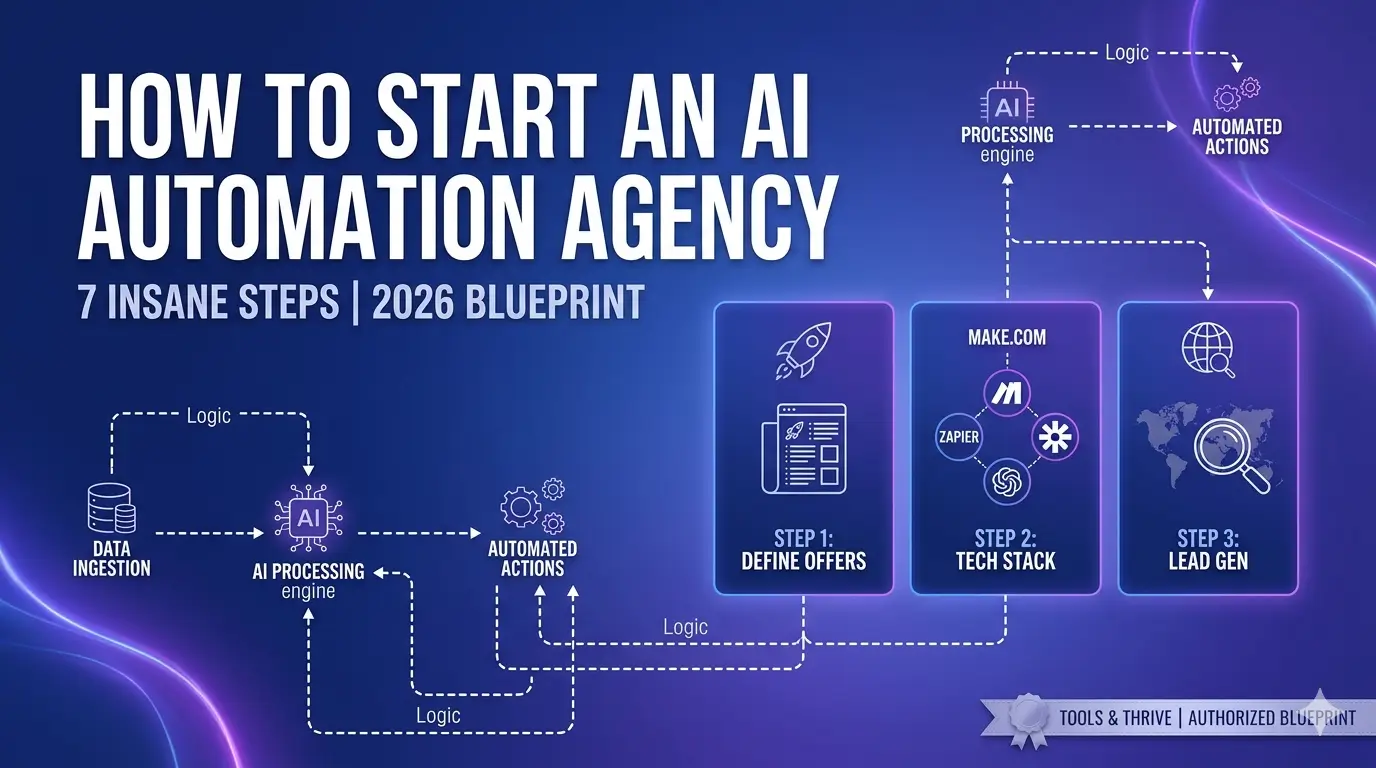
The AAA Core Structural Flow
1. Ingestion: Raw unstructured data is captured instantly from external sources via dynamic webhooks, API calls, or contact form submissions.
2. Processing Engine: Middleware environments parse incoming JSON objects, apply logical filters, and pass relevant strings securely to generative AI LLM endpoints.
3. Execution: The contextual output is formatted and sent directly to live targets, updating client databases or syncing remote infrastructure.
Step 1: Define Services for Your AI Automation Agency
Before you pitch a single client, you must define exactly what business problems you solve. Offering vague “AI consulting” packages rarely closes high-ticket B2B contracts. Master exactly how to start an ai automation agency catalog by packaging your operational solutions into explicit, productized assets:
- AI Outbound & Lead Gen Infrastructure: Automating scraped records processing, context-aware email sequences, and real-time CRM updates.
- Customer Support AI Agents: Building trained internal support systems using conversational layers to handle client validation 24/7.
- Content Optimization Pipelines: Streamlining asset management, distribution logs, and multi-channel publication frameworks tailored toward monetization strategies such as high-CPM niches.
For operators reviewing execution models, map out your delivery systems early. If you focus on a specific offer, scaling your brand-new infrastructure becomes much faster than rewriting layouts for every individual client path.
Step 2: Master Your No-Code AI Tech Stack
You do not need to be a senior software engineer to establish a digital agency. Mastering how to start an ai automation agency framework comes down to understanding visual logic charts, processing structural API payloads, and working with platform middleware. Explore our comprehensive AI business tools directory reference to pick your stack elements, which typically center around:
| Platform Name | Core Functionality | Strategic Core Focus |
|---|---|---|
| Make.com | Advanced Cloud Integrations | Connects disparate APIs using complex logic. Review the official Make.com advanced logic documentation to build deep data trees. |
| Zapier | Rapid Trigger Deployments | Excellent for basic application hooks and rapid sandbox testing loops. |
| Voiceflow | Conversational Frameworks | Builds highly interactive conversational nodes. Review structural Voiceflow design parameters to design human-first experiences. |
| Claude / OpenAI APIs | Underlying Intelligence | Provides text classification. Refer to the Anthropic Claude API reference logs for token structures. |
Step 3: Choose Your Target Industry Niche
One of the largest compounding errors new agency operators make when structuring their outreach blueprint is targeting “any business owner.” Broad outreach profiles look generic. To capture deep authority, select a dedicated industry vertical where back-end systems are heavily utilized:
- E-commerce Operations: Automate tracking data flow across storefront fulfillment systems, daily order logistics, and accounting sheets.
- Real Estate Brokerages: Deploy instant outbound SMS updates for inbound portal leads and sync scheduling matrices.
- Media & Content Formats: Streamline publishing and keyword tracking funnels focused primarily on scaling high-CPM niches for content platforms.
Step 4: Productize Your Offerings & Retainers
To ensure structural scaling, avoid charging by the hour. Hourly metrics safe-harbor baseline speed and efficiency. Designing your billing structures effectively is critical when optimizing how to start an ai automation agency pricing scheme for high-paying corporate clients.
The total implementation revenue can be modeled using a basic linear setup and recurring architecture fee structure:
Where $S_{setup}$ is your fixed initialization payment ($1,500 to $5,000+) and $M_{retainer}$ represents your high-margin monthly optimization fee ($300 to $1,200/mo) across operational timeframe $t$.
Step 5: Build a High-Converting “Proof of Concept” Portfolio
When building a scalable workflow model, discovering how to start an ai automation agency roadmap requires setting up clear diagnostic sandboxes. Businesses are naturally careful about sharing programmatic access to their core infrastructure with unverified partners.
To circumvent this problem, assemble an idealized Proof of Concept (PoC) system inside a demo workspace. Record an engaging, high-impact 5-minute video presentation showing the visual layout of your automation. Explain exactly how much administrative operational time the pipeline saves and how it minimizes database errors. This video operates as your primary asset for inbound and outbound closing plays.
Step 6: Launch Your Agency Outbound Outreach Strategy
With your video proof asset finalized, you can comfortably approach your market. Avoid burning cash on expensive ad networks during your first quarter. Rely instead on precise, high-intent direct prospecting pipelines using custom assets.
Subject: Quick infrastructure automation idea for [Company Name]
Hi [Owner Name],
I noticed your operations team manually flags data inputs between your platform logs, which introduces minor delivery delays. I put together a quick 3-minute video analysis showing how a secure cloud pipeline can sync those inputs instantly in under 60 seconds.
Here is the custom workflow design: [Loom Video Resource Link]
If this helps streamline your current engineering queue, let me know if you have five minutes for a quick introductory sync this week.
Best regards,
[Your Name]
AI Infrastructure Lead • Tools and Thrive
Step 7: Deliver Overwhelming Value and Gather Testimonials
Once your first contract is signed, prioritize flawless delivery. Document your technical processes meticulously, construct simple client-facing dashboards, and build clear documentation logs. Use tracking metrics to prove absolute return on investment: did your automation cut lead verification times down by 40%? Turn those definitive data milestones into high-converting text and video case studies to place on your homepage.
Summary: Your Next Action Steps
Building a modern automation agency requires zero background in writing code, but it demands an intense focus on business systems optimization. By locating repetitive friction points in operational models and integrating solutions via systems middleware, you establish a resilient, high-value asset.
- Initialize Stack Frameworks: Register corporate sandboxes inside integration platforms to master how components operate down to the API parameter.
- Design Asset Templates: Construct an active multi-step integration in a staging sandbox to demonstrate immediate value.
- Initiate Outreach Velocity: Distribute targeted workflow assessments daily to high-intent niche profiles.